The Admissions Office Was Built for a Different Century. Here's What Replaces It.
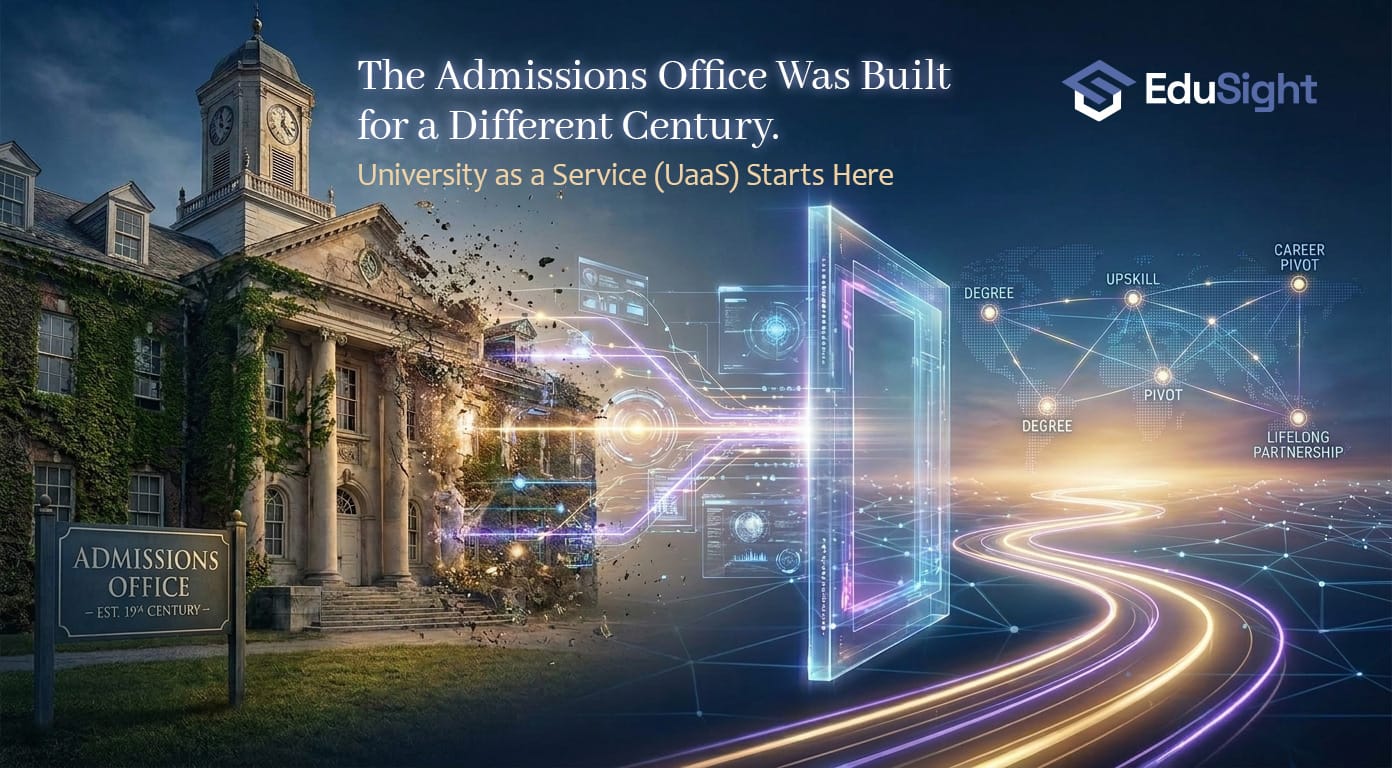
Why the global shift from recruitment to relationship demands an entirely new engagement infrastructure — and why most universities aren't ready.
A recent Forbes article by David Rosowsky argues that "the era of the admissions office as we know it is ending." His vision of the "60-Year Degree" — a model in which universities stop treating graduation as an exit and start treating it as an entry point into a lifelong partnership — is compelling. It is also, for most institutions worldwide, far from operational reality.
Because here is the uncomfortable truth that Rosowsky's thesis exposes: most universities haven't even mastered the first conversation with a prospective student, let alone a 60-year relationship.
A global crisis with local consequences
This is not a regional problem. The pressure on admissions and enrollment is intensifying on every continent simultaneously — and the causes are converging in ways that make the old playbook obsolete.
In the United States, the long-predicted enrollment cliff has arrived. The number of high school graduates peaked at roughly 3.9 million in 2025 and has since been in steady decline — a projected 13% drop through 2041. At least 16 nonprofit colleges closed their doors in 2025 alone, and more than half of private universities rated by S&P Global are running operating deficits. New international student enrollments — historically the financial lifeline — fell 17% in fall 2025, erasing over $1 billion in revenue and nearly 23,000 jobs.
The story is no better elsewhere in the Anglosphere. In Canada, new study permit approvals plunged by more than 60% — falling below COVID-era levels — with the government capping 2026 intake at just 155,000 new arrivals. In the UK, nearly 70% of universities reported declining international postgraduate enrolments for 2025–26, marking a second consecutive year of contraction. In Australia, student visa applications fell 32% after a barrage of policy changes and a doubling of the visa application fee to AUD $2,000.
The death of the educational burst — and the rise of University as a Service
Rosowsky's core argument deserves unpacking, because it reframes the stakes entirely. Higher education still operates on what he calls the "burst theory of learning" — a single, intensive period of full-time study between the ages of 18 and 22, followed by decades when formal learning is sporadic or absent.
This front-loaded model assumed a stability of knowledge and career trajectories that no longer exists. In the 1970s, an engineering degree could carry a practitioner through a full career with only minor adjustments. Today, the half-life of many technical, analytical, and even managerial skills has shrunk to less than five years. Generative AI hasn't just changed how we work — it has changed the fundamental value of the knowledge we acquired just a few years ago. If a university's value proposition remains tied solely to that initial four-year burst, it is selling a product with built-in obsolescence.
The solution Rosowsky proposes is architectural, not incremental: University as a Service (UaaS). Just as the tech industry pivoted from selling software in a box to offering SaaS, universities must pivot to a subscription-like model where alumni return every three to five years — physically or virtually — for stackable micro-credentials that serve as precision-engineered updates to their primary degree. An architect who graduated in 2015 needs a 2026 module on AI-driven structural optimisation. A marketing professional from 2020 needs an advanced module on generative AI, consumer intelligence, and AI-powered campaign automation. The university ensures the seal on the original diploma never loses its lustre.
In this model, the institution also becomes a research concierge — opening its billions of dollars in lab infrastructure, computing capabilities, and faculty expertise to alumni launching startups or leading divisions at Fortune 500 companies. It becomes a career architect for the professional pivots that will define 21st-century working lives, where the average person may make four or five radical career transitions before age 70. And AI becomes the connective tissue — every graduate could have a personalised AI agent to track employment trends, predict disruptions, suggest learning pathways, and guide them through career transitions, all branded by and deeply connected to their alma mater.
The new institutional KPI isn't a first-year headcount. It's what Rosowsky calls "total managed lives" — the number of individuals currently drawing value from the university's knowledge ecosystem. By broadening the base of active learners to include 35- to 70-year-olds, universities can decouple their financial health from the shrinking demographic of young adults and shift the alumni relationship from philanthropy-based to value-based.
It's a powerful vision. But it raises an immediate, practical question that most institutional leaders haven't confronted.
The UaaS gap: why most universities can't get there from here
If University as a Service is the destination, there is a chasm between the vision and what most institutions can operationally deliver today. The problem is not a lack of ambition. It is that the infrastructure required to sustain lifelong learner relationships at scale simply does not exist inside the traditional admissions and enrollment model — and bolting it on through conventional means will break the budget before it ever delivers results.
Consider what UaaS actually demands. A university must now engage not just with prospective undergraduates applying once, but with tens of thousands of alumni and working professionals who might re-engage at unpredictable intervals over decades. A 2015 graduate exploring a micro-credential in AI-driven supply chain management at 11 PM on a Tuesday. A mid-career corporate manager is comparing stackable certificates across three universities during a lunch break. A 50-year-old executive is weighing a leadership programme while travelling internationally. Each of these individuals expects the same instant, personalised, contextually aware experience they receive from every other digital platform in their lives.
Now try to serve that demand with the traditional recruitment playbook: hire more advisors, add more phone lines, send more email campaigns. The math collapses almost immediately.
The staffing problem is exponential. Traditional recruitment is built around a seasonal cycle — application windows, enrollment deadlines, and orientation periods. UaaS has no season. If your university is serious about lifelong engagement, enquiries arrive 365 days a year, across every time zone, from learners at radically different life stages with radically different needs. Staffing a human team to provide responsive, personalised engagement for a base of "total managed lives" that could be five to ten times the size of your current student body is financially prohibitive. Most universities already struggle to respond to prospective undergraduates within 24 hours. Extending that same model to a lifetime of touchpoints would require a tenfold expansion of enrollment staff — a cost structure no institution can sustain.
The knowledge problem is compounding. A traditional admissions counselor needs to understand one thing well: the path from application to enrollment. A UaaS advisor needs to understand micro-credential catalogues, industry-specific skill gap analyses, credit-stacking rules, corporate partnership structures, alumni career trajectories, and emerging workforce trends — and they need to contextualise all of that for each learner's unique situation. The training burden alone makes a purely human-driven approach unviable at scale.
The timing problem is fatal. Working professionals don't operate on academic calendars. Their moments of highest intent — the evening after a difficult performance review, the weekend after a layoff, the flight home from a conference where they realised their skills are falling behind — are fleeting. If your institution can only engage during office hours, with a 24-hour callback promise, you lose those learners not to a competitor, but to inertia. The window closes, the moment passes, and they never come back.
This is the fundamental paradox of UaaS: the vision requires a scale and responsiveness of engagement that the traditional model was never designed to deliver, and attempting to deliver it through human staffing alone would cost more than the revenue it generates.
The engagement gap nobody talks about
The UaaS paradox doesn't begin at the alumni stage. It is already visible in the very first interaction most universities have with prospective students — and it reveals just how far the sector has to travel.
Roughly 70–80% of prospective students who visit a university's website leave without ever enquiring. Of the leads that are captured, 40–50% go cold before a human ever responds. And a majority of high-value enquiries — the graduate student in LA comparing tuition fees on their phone at midnight, the working professional in London researching part-time MBA options at 2 AM, the international applicant in Singapore weighing three programmes during a holiday break — arrive outside of office hours when no one is there to answer.
This isn't a marketing problem. It's an engagement infrastructure problem. Universities are spending millions to generate demand, then losing that demand through a fragmented, manual, and fundamentally reactive admissions process. The leak isn't at the top of the funnel. It's in the middle — in what we call the Engagement Gap.
And here is the critical insight: if universities cannot close this gap for traditional undergraduate recruitment, they have no hope of sustaining the always-on, multi-decade, multi-segment engagement that UaaS demands.
Why static websites and legacy tools aren't the answer
The default institutional response has been predictable: redesign the website, install a CRM, hire more advisors. But these solutions address symptoms, not the underlying architecture of the problem.
Today's prospective students — 92% of whom already use AI tools in their studies — expect the same instant, personalised experience from their future university that they get from every other digital platform. They prefer self-discovery through AI search, WhatsApp, and institutional websites. They demand control over their exploration process. And if they encounter friction or cannot find clear answers within seconds, they don't complain. They silently disengage and move to the next institution on their list.
The challenge intensifies for universities offering complex programme portfolios. When an institution offers dozens of postgraduate specialisations, professional certificates, executive education tracks, and — in the UaaS future — stackable micro-credentials, a static FAQ page is not a strategy. It's a barrier.
AI as the bridge to University as a Service
If traditional recruitment infrastructure cannot scale to meet the UaaS vision, and legacy engagement tools cannot deliver the depth of interaction that lifelong learners demand, what can?
The answer is AI-powered Admissions Intelligence — not as a cost-cutting measure, but as the foundational infrastructure that makes University as a Service operationally possible.
This requires a fundamental conceptual shift: from recruitment to Admissions Intelligence. The difference is not incremental. Recruitment asks, "How do we get more leads?" Admissions Intelligence asks, "How do we understand every prospective and returning learner the moment they arrive — and respond with the right information, in the right language, at the right time, before the window of intent closes?"
AI makes always-on engagement economically viable. An AI-powered engagement layer can operate 24/7, across languages and time zones, handling thousands of simultaneous conversations with the contextual depth to address the most sophisticated queries a prospective student can ask — whether they're a first-time applicant in Dhaka or a returning alumnus in Denver exploring a micro-credential. What would require hundreds of additional staff in a traditional model becomes a scalable infrastructure layer that grows with the institution's ambition.
AI connects career pathways to learning opportunities in real time. This is where the UaaS vision becomes tangible. An intelligent engagement platform doesn't just answer questions about programme requirements and fee structures. It can understand a prospective learner's current career situation, map it against emerging industry trends, and connect them to the specific credential, module, or programme that advances their trajectory. The mid-career data analyst who enquires about upskilling isn't just handed a course catalogue — they're shown a personalised pathway from where they are to where the market is heading, with the university's offerings woven into every step. This is the engagement model that turns a one-time applicant into a lifelong learner.
AI reads intent and acts on it instantly. Not all enquiries are equal. A prospective student who has visited the programme page four times, compared fee structures, and asked about scholarship eligibility is demonstrating profoundly different intent from someone who typed "Hello." Yet most admissions processes treat them identically — both get the same autoresponder, the same brochure PDF, the same 24-hour wait for a human callback. AI can read these intent signals in real time, routing high-intent prospects to human advisors with full context while nurturing earlier-stage explorers with the specific information they're actually seeking.
AI liberates advisors to do what only humans can do. The highest-paid, most experienced members of an enrollment team should not be spending their mornings triaging hundreds of unorganised messages to find the handful of students who are ready to commit. That is a catastrophic misallocation of human talent. When AI handles the qualification, the contextual response, and the scheduling, advisors are liberated to do what they do best: build relationships, tell the institutional story, and guide students through complex decisions. Their first conversation with a prospective student is no longer a cold introduction. It is a warm, informed consultation — because the intelligence layer has already done the groundwork.
AI scales the follow-up that humans cannot sustain. In both traditional recruitment and the UaaS model, follow-up is where most institutions fail. A prospective student who expressed interest but didn't enrol. An alumnus who browsed a micro-credential page but didn't register. A working professional who started an application but abandoned it. In a human-only model, these individuals fall through the cracks — there simply aren't enough hours in the day. AI can maintain persistent, personalised follow-up across thousands of learners simultaneously, re-engaging them at precisely the right moment with precisely the right message, and connecting their evolving career goals back to what the university offers.
The road from here
Rosowsky's vision of a 60-year partnership between universities and their learners is the right north star. The University as a Service model — with its stackable credentials, research concierge access, AI-guided career architecture, and total-managed-lives KPI — represents where the best institutions will eventually arrive.
But universities cannot build perpetual relationships on a foundation of broken first impressions. Before the lifelong partnership comes the first conversation — and for most institutions globally, that conversation is still happening too slowly, too generically, and far too late.
The technology to close the Engagement Gap exists today. AI-powered admissions intelligence platforms can operate around the clock, across languages and time zones, with the contextual depth to handle the most sophisticated queries a prospective student or returning learner can ask. They don't replace human advisors; they make advisors radically more effective by ensuring they spend 100% of their energy on relationship-building — not chasing.
The question for university leaders is no longer whether to adopt this infrastructure. It is whether they can afford the cost of waiting while their competitors already have.
The EduSight team builds AI-powered Admissions Intelligence platforms for universities worldwide. Learn more at edusight.ai.