The Intelligent Advantage: Why AI is Your Team’s Best Strategic Partner, Not Its Substitute.
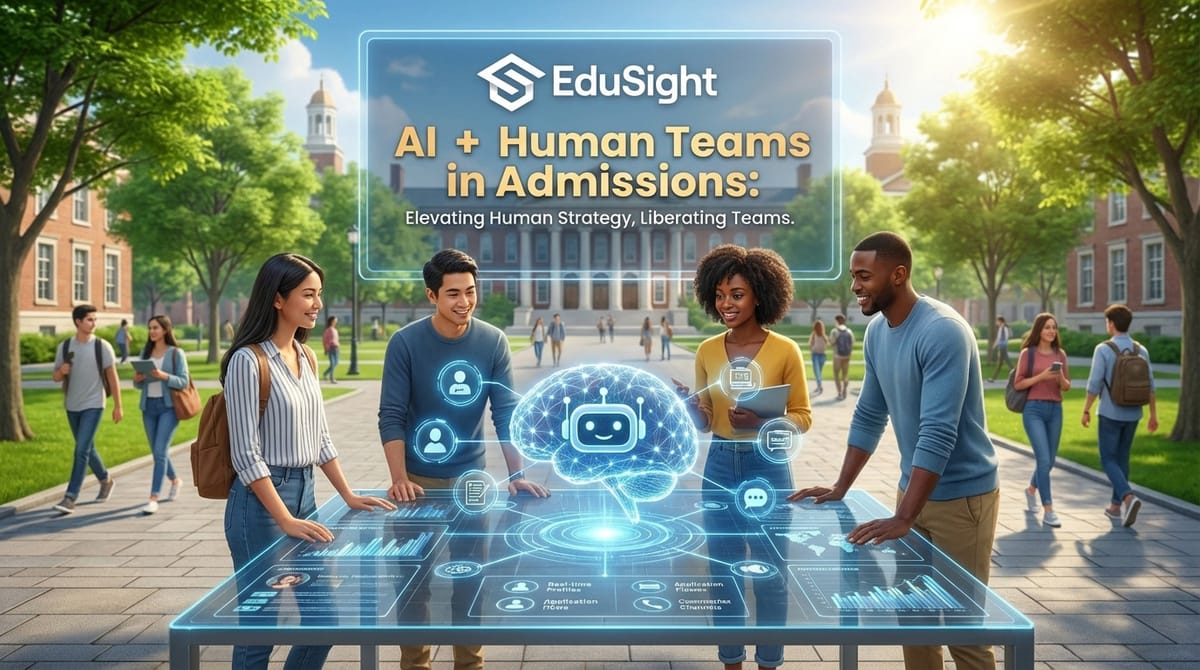
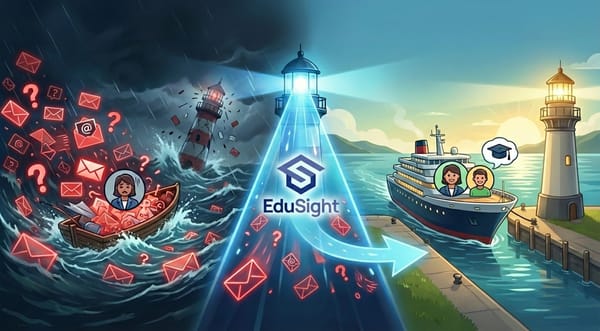
It’s 11:47 PM on a Tuesday. An admissions advisor’s phone buzzes on their nightstand. They shouldn't look, but they do. It’s an email from a high-achieving prospective student in a time zone eight hours ahead. The question is specific: "If I transfer my 15 credits from my community college and major in Nursing with a minor in Spanish, can I still guarantee graduation in two years while working part-time?"
The advisor knows the answer. It’s complex, it requires nuance, but they know it. They also know that if they don’t answer now, that student might take their question—and their enrollment—to a competitor who responds faster.
They sigh, open their laptop, and type out a response.
This scenario is played out thousands of times a night across the higher education landscape. It is the symptom of a system pushed to its breaking point. We are operating in an era where the speed of information has outpaced human capacity, yet we are still relying on institutional structures designed for a 9-to-5 world.
The narrative surrounding Artificial Intelligence in admissions often centers on a primal professional fear: replacement. But if you look closely at the data defining the modern student journey, the real danger isn’t that AI will replace human teams. The real danger is that without AI, human teams will burn out trying to do a job that is no longer humanly possible.
The Funnel is Dead. Welcome to the "Orbit."
For decades, the admissions model was comforting in its linearity. We called it a "funnel." Institutions poured awareness into the wide top, nurtured prospects through the middle, and yielded enrolled students at the bottom. This model assumed two things that are no longer true: that information was scarce, and that the institution controlled the pacing of the journey.
According to the rigorous 2026 Modern Learner Report by EducationDynamics (EDDY), that world is gone. The linear funnel has been replaced by a chaotic, non-linear "Orbital Model."
Prospective students no longer move predictably from awareness to inquiry to application. Instead, they circle institutions like satellites, constantly moving closer and drifting further away based on a continuous stream of new information, peer reviews, and algorithmic suggestions. They enter the process, pause, retreat, compare five other schools, and re-enter months later with entirely new constraints.
In an orbit, there is no "business hours." The gravitational pull of an institution depends entirely on its ability to provide instant gratification and relentless clarity. If a student encounters friction—a broken link, a vague FAQ page, a "we’ll get back to you in 48 hours" auto-reply—their orbit decays. They don't argue; they just float away to a competitor with stronger gravity.
The Three Unforgiving Constraints
What keeps a student in orbit? It used to be vague notions of prestige, campus culture, or the promise of a "transformative experience." Those still matter, but they are secondary.
The EDDY report identifies a brutal new reality: The decision-making process is now governed by three non-negotiable constraints, known as The Three Cs: Cost, Convenience, and Career.
These are not marketing pillars. They are gatekeepers.
In the legacy model, institutions could persuade students on culture first and discuss cost or career outcomes later. Today, if a student cannot immediately verify that a program is affordable (Cost), fits into their complex life without massive disruption (Convenience), and directly leads to a specific job outcome (Career), they will not even submit an inquiry.
- Cost Clarity: Students don't want sticker prices; they want to know their price, factoring in aid and transfer credits, immediately.
- Convenience as Infrastructure: Flexibility isn't a perk anymore. EDDY data shows that for non-traditional undergraduates, program format isn't a preference—it's a feasibility test. If the modality doesn't fit their life, enrollment is impossible.
- Career as the Anchor: Career outcomes are now the primary stabilizing force in the decision orbit. Students are intensely risk-averse. They need proof of ROI before they commit.
The pressure this places on human admissions teams is immense. They are no longer just evaluating applications; they are expected to be instantaneous financial advisors, schedule architects, and career advisors—simultaneously, for thousands of prospects.
The "Silent Melting" and the New AI Front Door
Perhaps the most terrifying finding for traditional admissions leaders is that most of this evaluation happens before the institution even knows the student exists.
The "front door" of the university has moved. It is no longer the campus visit or even the .edu homepage. It is generative AI.
The EDDY report reveals a stunning behavioral shift: In just one year, AI usage among prospective students searching for schools surged from 68% to 88%. Students are using tools like ChatGPT and Google's Gemini as sophisticated filtering agents. They ask AI to "list top nursing programs under $30k in the Northeast with hybrid options and high job placement."
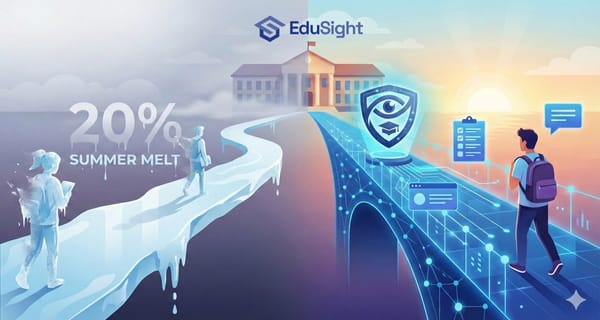
If an institution's value proposition regarding the "Three Cs" isn't clear enough for an AI to scrape and summarize, that institution is silently eliminated from consideration sets without ever receiving a single email. This is "silent melting," occurring at a scale human outreach cannot touch.
The Human Bottleneck: Why Effort Is No Longer Enough
This brings us back to our exhausted admissions advisor at midnight.
Institutions are trying to meet 2026 demands with 2010 infrastructure. The math simply does not work. The volume of inquiries, combined with the expectation for immediacy across multiple channels (email, social, chat, text), has created an unsustainable bottleneck.
Industry data paints a stark picture of the operational reality facing admissions offices:
- The Ratio Problem: During peak seasons, the typical advisor-to-prospect ratio can stretch to 1:500. Providing personalized, high-quality career counseling to 500 unique individuals is a statistical impossibility.
- The Speed Trap: Today’s digital-native students expect instantaneity. Data shows that 73% of prospective students expect instant responses to their queries.
- The Cost of Delay: The penalty for missing that window is severe. Up to 42% of qualified leads drop off due to delayed responses.
- The Timing Mismatch: The modern learner is active when admissions offices are closed. A staggering 60% of inquiries arrive outside standard business hours.
If your strategy relies on humans answering every question, you are failing 60% of your prospective students by default. You are forcing highly trained staff to spend their days—and nights—acting as human search engines, answering repetitive questions about deadlines and parking permits, rather than engaging in the deep, influential conversations that actually drive enrollment.
The problem isn't effort. Admissions teams are working harder than ever. The problem is alignment.
Entering the "Smarter" Era: The Role of EduSight.ai
The data leads to an inescapable conclusion: to survive in the orbital age, institutions must adopt infrastructure that matches the speed and complexity of the modern learner. This is not about replacing humans; it’s about liberating them.
This is the specific challenge that EduSight.ai was built to solve.
EduSight isn't just a chatbot; it is a comprehensive AI-powered recruitment partner designed to handle the immense volume of "Three C" constraints, allowing human teams to evolve into the strategic advisors the market demands.
By integrating EduSight, institutions can move from a reactive, overwhelmed posture to a proactive, "smarter" admissions model. Here is how EduSight addresses the critical failures of the legacy approach:
1. Solving the 24/7 Speed Imperative
The Problem: 60% of inquiries come in after hours, and delay causes 42% of leads to drop off.
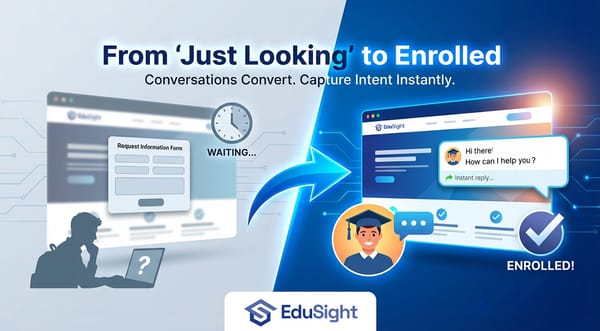
The EduSight Solution: EduSight provides an AI-Powered Conversational Engine that delivers instant, accurate responses 24/7/365 in over 95 languages. It doesn't just provide generic links; it is trained on your institution's specific programs, culture, and values to provide context-aware answers. A student asking about hybrid nursing options at 3 AM gets an immediate, comprehensive answer, keeping them in your institution's orbit.
2. Moving from Transactional Q&A to High-Value Counseling
The Problem: Admissions advisors with 1:500 ratios spend their time on repetitive FAQs instead of high-impact relationship building.
The EduSight Solution: EduSight acts as the first line of defense, handling the deluge of routine questions. But crucial to its design is Smart Qualification and Human Handoff. The AI identifies high-intent prospects through their questioning patterns. When a query requires nuance—emotional reassurance, complex financial counseling, or deep career alignment discussions—the AI seamlessly transfers the chat to a human advisor, providing them with the full context. This ensures human effort is focused entirely on the conversations that tip the scales on enrollment.
3. Managing the Chaotic, Multi-Channel Orbit
The Problem: Students engage across fragmented channels—website chat, WhatsApp, social media—making consistent messaging impossible.
The EduSight Solution: EduSight offers Multi-Channel Orchestration, managing conversations across all platforms from one unified dashboard. This ensures that a student receives consistent answers regarding the "Three Cs" whether they are on Instagram or your homepage.
4. Adapting in Real-Time
The Problem: The orbital model is volatile; student concerns shift rapidly, and historical data is less predictive.
The EduSight Solution: A Real-Time Analytics Dashboard tracks engagement patterns and identifies trending topics instantly. If suddenly 500 students are asking about a specific scholarship deadline or expressing concern about a new campus policy, leadership knows immediately and can pivot strategy.
Conclusion
The future of admissions isn't human OR AI. It is human AND AI, working in their respective zones of genius.
AI is the only tool capable of meeting the modern learner's baseline requirements for speed, accuracy, and 24/7 availability at scale. By handing that infrastructure over to a platform like EduSight, institutions buy their staff the most precious commodity of all: time. Time to connect, time to counsel, and time to sleep through the night without worrying about the inquiries they missed.
Sources used in this analysis include the "2026 Modern Learner Report: The New Enrollment Model" by EducationDynamics and data presented in the EduSight "Smarter Admissions" sales documentation.