The Science of Prioritization: Why Your Admissions Team is Missing High-Intent Students
The Monday Morning Paradox
Imagine this scenario: It is 9:00 AM on a Monday. An admissions counsellor sits down, coffee in hand, and opens their dashboard. Over the weekend, the university received 400 new inquiries.
On the surface, this looks like success. Marketing has done its job; the funnel is full. But for the counsellor, this isn't a victory—it’s a crisis of cognitive load.
Who do they call first?
- The student who filled out a generic "contact us" form on Friday night?
- The international applicant who downloaded a brochure on Saturday?
- The local student who asked a question about fees via the chatbot on Sunday morning?
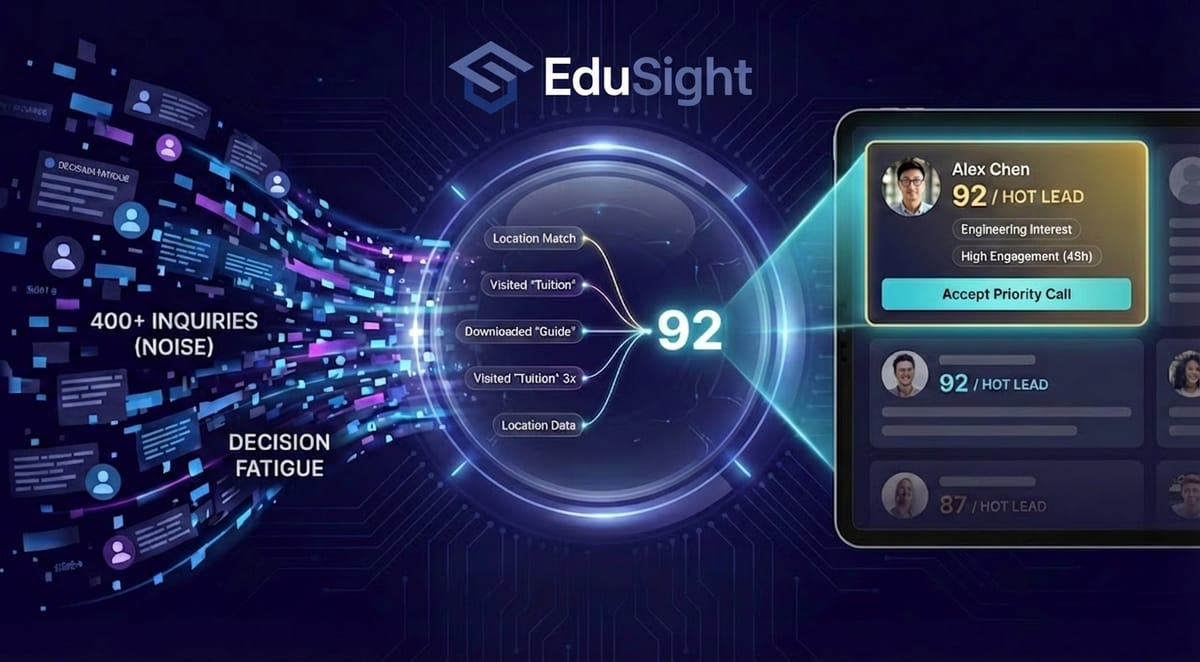
Without data-driven prioritization, counsellors often default to "Last In, First Out" (LIFO) or simply work alphabetically. While they spend 20 minutes qualifying a low-intent lead who was just browsing, a high-intent student—who visited the Tuition Fees page three times and downloaded the Engineering Faculty Guide—sits in the queue, waiting.
By the time the counsellor reaches them two days later, that student has already been contacted by a competitor.
This is the hidden cost of lead volume: When everything is a priority, nothing is.
The Problem: Decision Fatigue and "Lead Blindness"
Scientific research into decision-making points to a phenomenon known as decision fatigue. When professionals are forced to make constant, low-stakes decisions (like manually filtering through hundreds of Excel rows to guess who is interested), the quality of their subsequent decisions deteriorates.
In higher education admissions, this manifests as "Lead Blindness." Counsellors stop seeing students as individuals with specific needs and start seeing them as rows of data to be cleared.
The result?
- Response Lag: High-potential students wait too long for a human touchpoint.
- Counsellor Burnout: High effort on low-quality leads reduces morale.
- The "Silent" Churn: The best leads often don't shout the loudest; they exhibit subtle buying behaviors that human eyes miss in a spreadsheet.
The Solution: multidimensional Lead Scoring
The solution isn't to hire more counsellors to churn through lists faster. The solution is to change the order of the list based on intent, not just recency.
At EduSight, we approach this through automated Lead Scoring.
Think of Lead Scoring as a digital triage nurse. Before a student ever reaches a counsellor, the system evaluates them based on a composite of signals. It doesn't just ask "Who is this?" but "What has this person done?"
We calculate this score by looking at two distinct layers of data:
1. Explicit Data (Demographics & Profile)
This is the static information the student provides.
- Location: Is the student in a priority recruitment region?
- Academic Background: Do they meet the minimum entry criteria?
- Program Interest: Are they looking at a course you are actively trying to fill?
2. Implicit Data (Digital Body Language)
This is where EduSight changes the game. We track the behavioral signals that indicate genuine intent.
- Page Depth: Did they only visit the homepage, or did they spend 5 minutes on the Accommodation and Visa Requirements pages?
- Resource Engagement: Did they download a prospectus?
- Recurrence: Have they visited the site multiple times in the last 48 hours?
How It Works: Turning Data into a Score
EduSight processes these variables to assign a numerical value (0–100) to every profile.
Let’s compare two leads:
Lead A (Score: 25): Filled out a form on Facebook. Visited the homepage once. No further activity.
Lead B (Score: 85): Visited the website via a Google Search. Spent 10 minutes reading the "Computer Science" course page. Downloaded the "International Student Guide."
In a traditional workflow, Lead A might get called first simply because they filled out the form 10 minutes ago.
With EduSight, Lead B is flagged as "Hot" or "High Priority." The counsellor’s dashboard automatically sorts the list, placing Lead B at the top.
The Operational Impact: From Cold Calling to Closing
When you implement behavioral lead scoring, the conversation changes.
1. Counsellors approach calls with context.
Instead of starting with a generic "How can I help you?", the counsellor can see the high score was driven by visits to the Scholarship page. The opening line becomes: "I noticed you were looking into our scholarship options—would you like me to walk you through the application process?"
2. Efficiency skyrockets.
By focusing 80% of their energy on the top 20% of scored leads, counsellors secure enrollments faster. The lower-scored leads aren't ignored; they are nurtured via automated email workflows until their score increases.
3. Student experience improves.
High-intent students get the immediate attention they crave, while early-stage students aren't pressured by premature sales calls.
Conclusion
Your admissions team works hard. But in a landscape of overwhelming data, hard work alone isn't enough. You need to work intelligently.
By moving away from spreadsheets and adopting behavioral lead scoring, you ensure that no high-potential student is ever lost in the noise. It’s not about replacing the human connection in admissions; it’s about ensuring that connection happens with the right student, at the exact right moment.