UCL Campus Sri Lanka Had the Traffic. They Weren't Getting the Enrollments. Here's What Changed.
312% more after-hours leads. 45% higher conversion to enrollment. One shift in strategy.
Every admissions team knows the feeling. Your website traffic looks healthy. Your campaigns are driving clicks. But when you check your inquiry pipeline, it's full of ghost leads — incomplete forms, abandoned landing pages, and prospects who visited three program pages and vanished without a trace.
That was the gap Universal College Lanka (UCL) wanted to close. As one of Sri Lanka's most established private higher education institutions — the exclusive provider of Monash University pathways in Sri Lanka, alongside degree programs through Dalhousie University, Torrens University and the University of Lancashire (UK) — UCL had strong brand recognition and steady interest from students across the island. What they didn't have was a way to turn that interest into conversations at the moment it mattered most.
The Challenge Every Admissions Team Recognizes
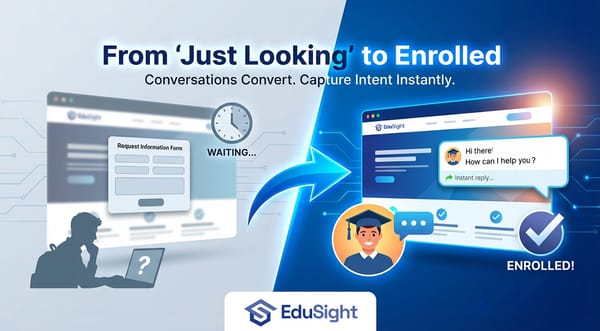
UCL's recruitment followed a familiar higher education playbook: drive traffic to program pages, funnel visitors toward a "Request Information" form, and let the admissions team follow up. It's the model most institutions still run. And increasingly, it's the model that's breaking down.
The reason is simple. Today's prospective students — particularly Sri Lanka's digitally native Gen-Z learners — don't fill out forms and wait 48 hours for an email. They expect the same instant, conversational interaction they get from every other app on their phone. Industry data backs this up: 73% of prospective students expect an instant response to their inquiry, and 60% of those inquiries come outside of regular business hours.
For UCL, this played out in a very specific way. A student exploring the Monash College Diploma of IT page at 10 PM — weighing whether UCL could be their launchpad to a Monash University degree in Australia or Malaysia — had real questions in that moment. What are the entry requirements? How much does it cost? Can I transfer after one year? The inquiry form couldn't answer any of those. And by the time a counselor replied the next business day, that student had often moved on.
The leads that did come through were a mixed bag. Some were high-intent students genuinely planning their pathway. Many were low-intent — people who filled out a form out of curiosity but never responded to follow-up emails or calls. UCL's admissions counselors were spending significant time sorting through this pipeline, chasing contacts who had already lost interest, instead of focusing on the students who were ready to take the next step.
This isn't a UCL-specific problem. It's an industry-wide shift that most institutions are grappling with. UCL simply decided to do something about it.
The Shift: From Forms to Conversations
UCL made a strategic decision: stop treating their website like a digital brochure and start treating it like a front desk.
They partnered with EduSight to replace their primary inquiry forms with an AI-powered conversational assistant, purpose-built for education. Instead of asking prospective students to fill out fields and wait, the assistant engages them in real-time — answering questions about programs, fees, admission requirements, and campus life the moment a student asks.
The change in student experience was immediate. A prospective student landing on UCL's engineering pathway page at 11 PM could now ask "What O/L results do I need for the Monash Diploma?" and get an accurate, institution-specific answer in seconds. Not a generic FAQ response — an answer trained on UCL's actual program data, fee structures, entry criteria, and transfer pathways to partner universities.
Several things made this particularly effective for UCL's context.
The conversational approach dramatically lowered the barrier to engagement. Students who would never complete a long inquiry form were happy to type a quick question — and once that first exchange happened, EduSight naturally guided them through a micro-conversion, collecting contact details through dialogue rather than demanding them upfront.
For a Sri Lankan institution, multilingual capability mattered. Many students and especially parents are more comfortable in Sinhala or Tamil than English. EduSight's AI supports natural conversations in over 95 languages, which meant UCL could engage families in the language they think in — not just the language the website was built in.
The assistant also extended beyond UCL's website to WhatsApp — the dominant messaging platform in Sri Lanka. Students could continue conversations, ask follow-up questions, and receive updates on a channel they already use daily. This wasn't a separate system; it was the same AI, the same conversation context, simply meeting students on the platform they prefer.
And because the assistant was available around the clock, UCL stopped losing the late-night and weekend prospects who make up the majority of their traffic.
Behind the scenes, every conversation was also doing the work that used to fall entirely on human counselors: qualifying leads. High-intent prospects — students asking about application deadlines, fee payment plans, or how the 2+2 transfer model works with Dalhousie — were automatically flagged and routed to the admissions team for personal follow-up. Meanwhile, routine questions were handled instantly, without consuming counselor time.
All of this data flowed directly into UCL's CRM through EduSight's integration layer, giving the admissions team a complete picture of each prospect's journey — what they asked, what programs they explored, how engaged they were — before a counselor ever picked up the phone.
Going Live in Days, Not Months
UCL's deployment took about a week.
The process was collaborative: UCL's team provided their program information, course fees, transfer pathway details, and frequently asked questions. The EduSight team trained the AI on that content and built custom conversation flows around specific program interests — so a student exploring the Monash business diploma got a different guided experience than one researching the UCLan software engineering degree.
The technical deployment was lightweight: a script tag on their website. No heavy IT lift, no months-long integration project, and no disruption to existing operations.
On the compliance side, EduSight's platform is GDPR-ready and ISO 27001 certified — important for UCL given their partnerships with UK and Australian universities and the cross-border nature of student data in transnational education.
The Results
Within the first intake cycle after deployment, UCL saw measurable impact across their entire recruitment funnel:
312% increase in after-hours lead capture. The leads that were previously lost to closed offices and unanswered forms were now being captured and qualified automatically — every evening, every weekend, every holiday.
68% reduction in counselor workload on routine inquiries. Admissions staff stopped spending their days answering "What are the fees for the Monash pathway?" for the hundredth time and started investing that time in the conversations that actually move students toward enrollment.
45% improvement in student conversion rates. More students moved from initial inquiry to enrolled status. When you answer someone's question in the moment they're asking it, they don't go looking for another institution that will.
Measurable new revenue from the first intake. The improved conversion rate translated directly into additional enrolled students and tuition revenue — real financial return within the first recruitment cycle.
As UCL's Director of Admissions noted: "EduSight didn't just improve our metrics — it transformed how we connect with prospective students."
What This Means for Your Institution
UCL's challenges weren't unusual. Most education institutions today are dealing with some version of the same reality: website traffic that doesn't convert, inquiry forms that students skip, and admissions teams stretched too thin to follow up on every lead personally.
What set UCL apart was a willingness to change the interaction model. Instead of asking students to conform to an institutional process — fill out this form, wait for our reply — they met students where they already were: on the website at 11 PM, on WhatsApp between classes, with questions that needed answers now.
The shift from forms to conversations isn't a technology trend. It's a recognition that recruitment is a relationship — and relationships start with a conversation, not a form submission.
Ready to see what conversational recruitment could look like at your institution? Talk to the EduSight team →