Your Students and Parents Are Asking AI Which School to Attend. Here Is How to Make Sure It Mentions Yours.
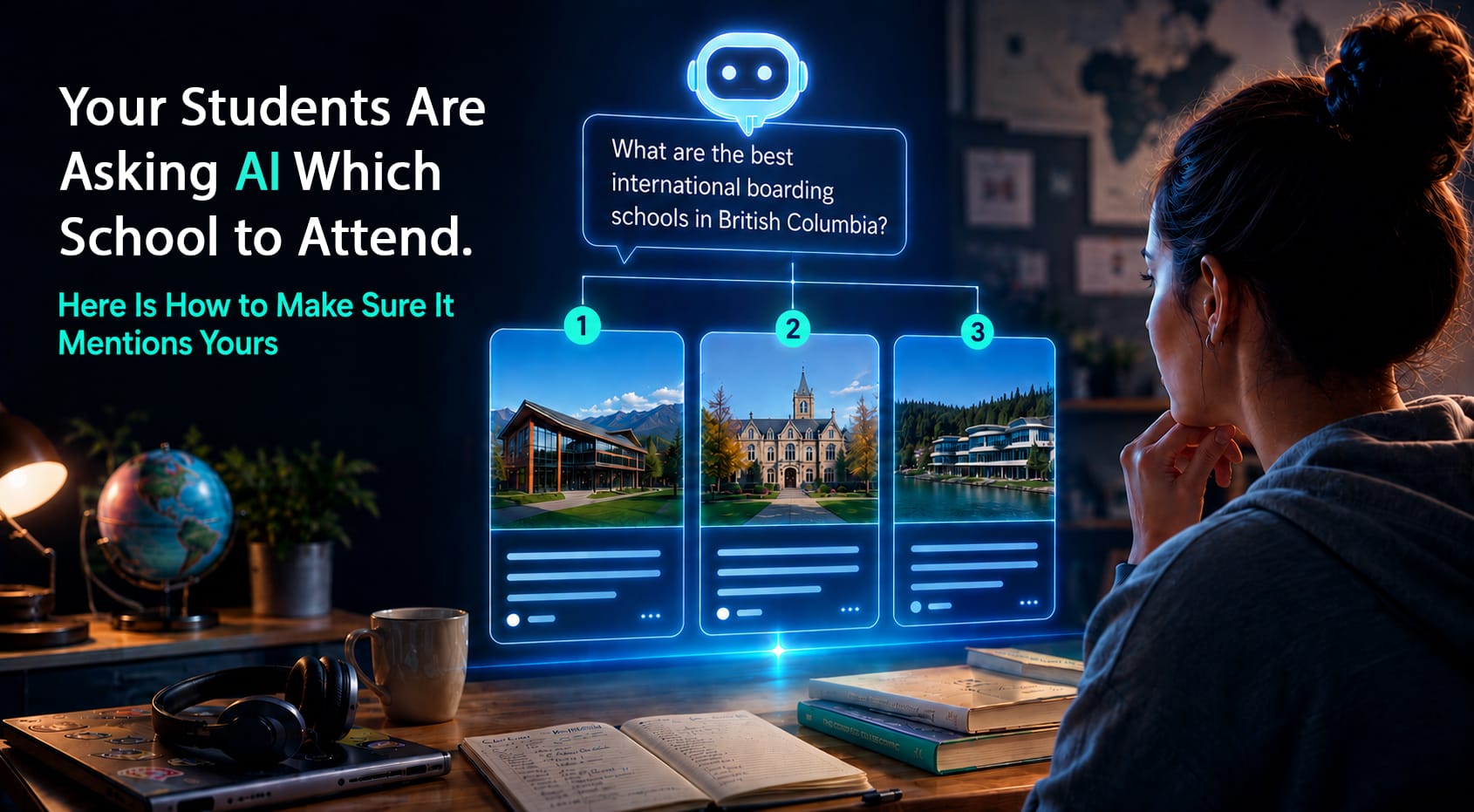
Open ChatGPT right now and type: "What are the best universities for computer science in Canada?" Or: "Which international school should my child attend in Singapore?" Or: "Top colleges for nursing in the UK?"
The AI answers in seconds. It names three to five institutions. Is yours one of them?
For most schools, universities, and colleges, the honest answer is: they have no idea. And that is the problem. 46% of college-bound students now use AI tools during their school search, and parents are following close behind, using tools like Gemini and Perplexity to build shortlists before they ever visit a website. AI-sourced traffic converts at three times the rate of organic search. The decisions are being made on engines most admissions teams are not watching.
Improving your AI search visibility is not one thing. It is three connected challenges, and institutions that are pulling ahead are tackling all of them together.
- Pillar 1: Get Found. When a student or parent asks an AI which institution to choose, do you appear in the answer?
- Pillar 2: Convert the Demand. When they arrive at your website or message you directly, does someone answer them, in their language, at any hour?
- Pillar 3: Keep Serving and Keep Learning. After they enroll, are you still serving them? And is every conversation feeding data back so your recruitment strategy gets smarter over time?
Here is what each pillar means in practice.
Pillar 1: Get Found
Appearing in AI recommendations is not the same as ranking on Google. In fact, fewer than 10% of sources cited by AI engines rank in the Google top 10 for the same query. Strong SEO is not a proxy for AI visibility. This emerging discipline has its own name: Generative Engine Optimization, or GEO.
AI engines decide who to recommend based on three signals.
The first is how widely your institution appears across the web. Not just your own site, but academic directories, press coverage, ranking publications, and third-party databases. 68% of AI citations come from third-party sources. Your website alone accounts for only 32%. For a student asking ChatGPT which college to apply to, the AI is pulling from everything it has ever learned about your institution, and most of that learning comes from outside your control.
The second signal is content quality. Brochure language does not get cited. Verifiable, specific, answer-ready content does. Research from Princeton and Georgia Tech shows that pages with statistics are up to 40% more likely to be cited by generative AI. "We offer world-class programmes" gets ignored. "Our engineering programme admits 120 students annually and reports an 87% employment rate within six months of graduation" gets used.
The third signal is structure. 61% of AI-cited pages use structured data markup. Clear heading hierarchies and schema tags help engines understand and synthesize what your pages contain. This is often the fastest single improvement a school, college, or university can make.
Language matters too, especially for institutions recruiting internationally. A parent in India asking about schools in Hindi, or a student in South Korea asking about university programmes in Korean, is querying a completely different competitive landscape. AI visibility in English alone is incomplete if your target families live and search in other languages.
Pillar 2: Convert the Demand
Appearing in an AI answer is only half the battle.
The other half happens in the next five minutes. A parent in Mumbai finds your university through ChatGPT at 11pm their time. They have questions about fees, entry requirements, and accommodation. Your admissions office is asleep. They submit a form and wait. Two days later, they have already shortlisted two other institutions that responded immediately.
This is where most institutions leak the most demand. Not in the AI answer itself, but in the silence that follows it.
Students and parents who discover an institution through AI are high-intent. They have already researched, they already have a shortlist, and they are ready to engage. The first institution that responds meaningfully sets the pace. Schools and colleges that take days to reply are playing catch-up in a conversation that has already moved on.
For international recruitment, the channel matters as much as the speed. WhatsApp is the dominant messaging platform across South Asia, the Middle East, and Southeast Asia, with roughly 2 billion active users worldwide. A family in Nigeria or Indonesia does not expect to email a university and wait. They expect a message, and they expect a reply. Institutions that engage via WhatsApp in a family's own language, within minutes of their first message, are not just more responsive. They are structurally more competitive in those markets.
Pillar 3: Keep Serving and Keep Learning
The institutions pulling ahead are not just answering AI-driven inquiries. They are learning from every one of them.
Which markets generate the most inquiries? Which actually convert to enrolments? Where does the funnel leak between inquiry and application? Historically, these questions were answered with guesswork or partial CRM data. An institution that logs every AI-driven conversation by market, language, programme, and intent starts to see a real picture. It turns out that one market converts at twice the rate of another, even though the second generates more volume. Budget shifts. Recruitment strategy sharpens.
That data layer is what makes AI strategy compound over time. Visibility brings the inquiry. Inquiry handling captures it. The data tells you how to improve both next cycle.
The same principle extends beyond recruitment. Students and parents still have questions after enrolment: financial aid deadlines, course registration, campus resources. The platform that answered a prospective student's first question before they applied can keep answering once they arrive. That reduces repetitive load on student services teams, keeps students engaged, and surfaces issues before they become retention problems. According to Inside Higher Ed, institutions prioritizing AI visibility are already building this kind of integrated approach, not treating recruitment and student success as separate problems.
Where to Start
The three-pillar picture can feel large. But the practical first step is straightforward: understand where your institution actually stands right now, across every engine that matters, against the schools competing for the same students.
That means running a proper audit. Not one prompt on one platform, but a structured test across ChatGPT, Gemini, Claude, and Perplexity, in English and in the languages your target families actually search in, scored against your direct competitors. The result is a clear baseline that shows which engines are working for you, where the gaps are, and what to address first.
Edusight Discover does exactly this. A 50-prompt audit across all four major AI engines, benchmarked against your competitors, run in your target market languages. You receive an AI Visibility Score and a prioritized set of actions without needing to build the methodology or interpret the data yourself.
The institutions building AI visibility now will be cited for years. AI engines concentrate recommendations on a small number of institutions per query type, which means early movers establish positions that become progressively harder to displace. The ones waiting are handing that ground to someone else.
Request a free AI Visibility Report at edusight.ai.
Sources
- EAB: Nearly Half of High School Students Now Use AI in College Search
- Omnibound: Generative Engine Optimization Statistics 2026
- Princeton / Georgia Tech: GEO Research Study
- UPCEA: AI Search in Higher Education — Student Search Trends
- Inside Higher Ed: To Reach Students, College Marketers Prioritize AI Visibility (February 2026)
- 5W Research: Online Universities AI Visibility Index 2026
- Meltwater: AI Visibility in Higher Education Recommendations